
"How Shall I Call You?" — A Transgender Art Workshop Exploring Gender Identity Through Life Portraits|VIVA LA VIDA × Pineapple in Action
- vivabranding
- Jul 18
- 5 min read
Updated: 3 days ago
Physical characteristics and the gender options provided on official forms are often used to identify a person’s gender.While this may appear reasonable on the surface, what about those who do not fit within these categories?
Their inner selves cry out:
“This is not me.”
They do not identify with the sex assigned to them at birth, nor do they wish to be confined within a binary understanding of gender.
They are transgender individuals.
Their voices may be faint, but they have always existed.
Through this transgender art workshop, we chose to listen to their voices and create a space where different experiences of gender identity could be seen and understood.
n September 30, 2022, Viva la Vida (VIVA), together with Pineapple in Action, jointly initiated the online transgender art workshop “How Shall I Call You?”, creating a space for participants to explore gender identity through art and dialogue.
01 Interactive Activity:
Building Connections Through a Transgender Art Workshop
The facilitator introduced the transgender flag and explained its meaning to participants. Everyone was then invited to mark their own position on the flag, creating a shared symbolic space that fostered emotional connection and mutual recognition.
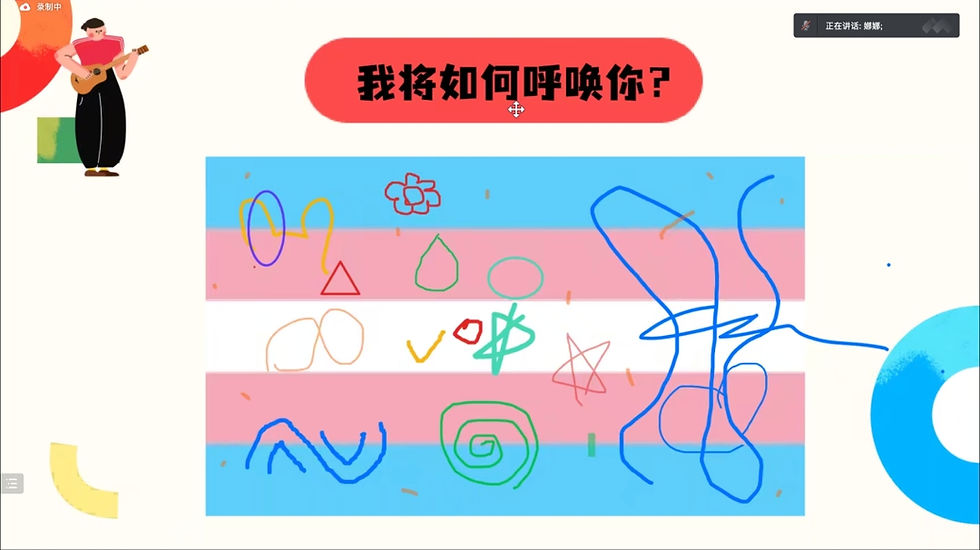
Participants took part in the interactive activity together.
02 Guest Sharing:
Exploring Gender Identity Through Personal Stories

Xingkai
Xingkai, current coordinator at ColorsWorld, highlighted the multiple forms of violence faced by transgender and non-binary (TNB) communities, including but not limited to coercive control, financial restriction, sexual violence, and physical violence. These challenges represent only the tip of the iceberg of what the community experiences.
"At times, we seem to instinctively place gender-diverse individuals into a "special" category, within which they face significant pressure. But why do we shift this tension from individuals onto an entire group, and then direct hostility toward everyone within that group?
Gender often feels like an inherent label. If we submit to the constraints of that label, we are passively assigned a wide range of expectations—both positive and negative—that ultimately restrict our lives. What distinguishes transgender experiences from cisgender ones is the opportunity to re-examine gender itself. If given the choice, what kind of gender would we hope for? And what kind of life might that envisioned gender bring?
I do not want to live my brief life shaped by others’ expectations and influence. I want to embrace life fully, and I hope everyone can set aside prejudice and stereotypes to see their authentic selves."

Anthony
Anthony, an interdisciplinary scholar in gender studies, intercultural studies, and sociology, shared lived experiences across different stages of life as a genderqueer individual. Anthony described himself as:“I engage in self-performance more frequently than most people.”
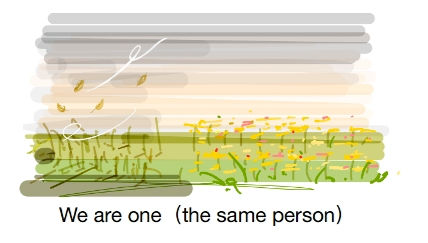
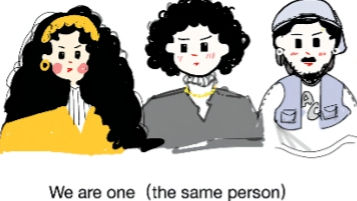
Anthony’s Life Portrait Sharing
"What is drag? Drag is, in essence, a subversion of traditional biological sex. It is also an exploration and re-expression of one’s desired or internal sense of gender.Thus, for drag performers and transgender communities, performance becomes a form of expression—one that reflects and reinterprets historical and societal understandings of gender and power, while also serving as an evolving process of self-exploration.
In my life portrait, you can see a garden filled with many vibrant and beautiful flowers, but also some weeds and withered blooms. Life is much the same. Beyond appreciating its beauty, we must also tend to it from time to time—continuously cultivating both ourselves and our rhythm of life to create a better space for growth.And when you truly understand how to do this, you realize that your life becomes natural and honest. The things you like begin to unfold, and the things you don’t care about no longer affect you.
Regardless of who we are, we should all find something that belongs to us—something that makes us feel unique and happy. You need to find a rhythm of life that truly belongs to you. Once you find your own position and pace, everything becomes naturally simpler."
03 Life Portrait Sharing:
Expressing Gender Identity Through Art
Through life portrait art, participants explored personal experiences, emotions, and understandings of gender identity in their own ways. Selected works are presented below, with additional works to be released gradually as part of the “Daily Signature” series.

“In gender stereotypes, pink is often associated with girls and blue with boys. In reality, the association between gender and color is entirely socially constructed. Such categorization subtly restricts individual choices and suppresses many authentic thoughts and feelings. In this artwork, the tear on the left and the mouth on the right use each other’s colors, symbolizing a hope that sincere tears and words can break through these stereotypes, allowing everyone to become their true selves, free from the constraints of a binary understanding of gender.”
——Yin Yuan
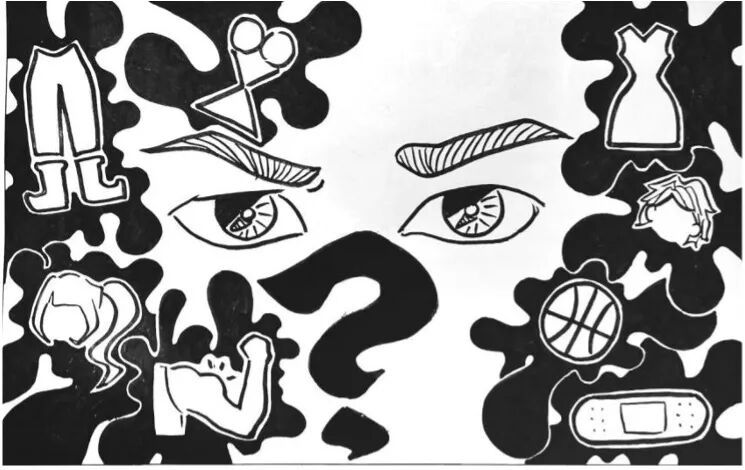
“When I first thought about the theme of this event, certain images came to mind—elements such as outfits, clothing, body shape, and personal preferences. These are all things that actually blend both masculine and feminine traits.”
——Chris

“My gender identity is genderqueer. It is, to a large extent, a form of self-expression within social relationships. In the process of seeking love or intimate relationships, we may encounter comparatively more difficulties. I do not really want to be defined by others, and I still hope to have the courage to be myself.”
——Tobias

“Although biological sex is difficult to change, a person’s social gender is fluid and can be self-determined. At the same time, who one chooses to interact with, and the gender of the people one chooses to form relationships with, are personal decisions that should not be interfered with by external forces.”
——qwq

“This artwork aims to express that in a social environment where binary gender is the dominant norm, each individual’s process of exploring their gender identity and sexual orientation while growing up can be extremely isolating and difficult. I hope people are not constrained by any labels. We should first accept and embrace ourselves, and allow ourselves to be fluid. We should accept difference, diversity, and fluidity—many problems would then naturally be resolved.”
——Little Dinosaur

“When a rose looks into the mirror for the first time.”
——Yolanda
Through this workshop, we collectively explored transgender-related topics and co-created “life portraits.” Ultimately, the goal is to see one another, connect with one another, and move forward together.The theme “How Shall I Call You” is itself an unfinished sentence. As many participants emphasized: We are who we believe ourselves to be.
“You take a leap into the air, confident that I will catch you.”
German scholar Elisabeth Noelle-Neumann discussed media responsibility and once stated:“It defines the boundary of what can be socially accepted. It can transform prejudice into emotion, darkness into light, and make the invisible visible.”
We offer our full, unbiased respect. From the environment around us, individuals may gain the courage to become themselves. In the end, only each person can define who they are.
04 Partner Organizations


Viva la Vida (VIVA) is an international organization active in more than 50 countries. It inspires young people to reflect on life, understand themselves, and use art as a medium to perceive life and build meaningful emotional connections with others. To date, VIVA has become a globally influential cross-cultural IP. Its partners include the United Nations, G20 YEA, APEC, Facebook (now Meta), Toutiao, Alibaba, and China Unicom.

Pineapple in Action focuses on gender-based violence (GBV). It raises awareness through diverse global voices and works to connect survivors so they can speak out. By amplifying discussions around gender-based issues, it aims to improve social conditions and promote gender equality.


Comments