
What are the young people of Afghanistan thinking?|VIVA LA VIDA Curator Mo Wen
- vivabranding
- Jul 25
- 8 min read
The people of Afghanistan are fond of saying: ‘Life goes on.’ They pay no heed to beginnings or endings, success or failure, imminent peril or unexpected relief; they simply press on, slowly and wearily, like nomads.
— Khaled Hosseini, "The Kite Runner"
Afghanistan, a country that seems so distant, yet shares a 92.45-kilometre border with us.
What are its young people thinking?

Turn left, and there is pain; turn right, and there is fear.
When the two merge, there is nowhere to go.
“Duality becomes mutuality. Pain plus fear is the confusion of the spirit. When you turn your head left and right – you don’t know where to go.”
Children: Full of Hope Amidst Violence

Curator Mo Wen holds an art exhibition in Afghanistan
Viva curator artist Mo Wen says that since arriving in Afghanistan, her life has been under serious threat; for instance, Kabul frequently experiences terrorist bombings and suicide attacks, and one might lose their life simply whilst walking down the street one day.
Consequently, she couldn’t help but feel curious about the Afghan people, wanting to know what beliefs encourage them to carry on living in such an insecure environment, and at the same time, what causes them to feel fear and dread.
In her experience, when asking people from all walks of life in other countries, “What has made the greatest impression on you?”, very few would mention the word ‘violence’.
However, whilst conversing with the Afghans around her, she discovered that violence pervades their lives — from children to adults, every moment is steeped in violence.
Violence by adults against children, by men against women, by strangers against strangers, by certain nations against Afghanistan, and by terrorists against ordinary civilians — it is everywhere.
Mo Wen recalls that whilst speaking with some adults, one person told her that as they were growing up, they had to constantly get into fights with others. They fought out of a need for self-preservation.
If they did not fight back or engage in brawls, they might well have died at the hands of others, or fallen to someone’s blade. So, for them, fighting is simply a fact of life.
Yet in the children’s drawings, there is no trace of violence.
On the one hand, they have become desensitised to it; on the other, the children seek to conceal these realities. They wish to show you the positive aspects of their lives, not to give the impression that fighting and violence are an everyday occurrence.
Becoming teachers, doctors and engineers
If you ask Afghan children what they hope to become in the future, they will mention only three professions.
To become a teacher, a doctor or an engineer.
These are all professions that Afghanistan as a whole currently needs: engineers to rebuild the country, doctors to treat those injured by war and terrorist attacks, and teachers to educate the students.

Their first thought is that these professions will help the country and serve the nation and its people. So they do not speak of becoming businesspeople to make money; from a young age, they are taught that life is about serving others.
Serving others, serving the country, serving the people – whilst also earning a little money.
These children say they want to become doctors, teachers or engineers, but the reality they face right now is that they are selling chewing gum on the streets or washing cars for others. How can we change their fate?

The child currently sells chewing gum and washes cars, and hopes to become a teacher in the future
Mo Wen said that after arriving in Afghanistan, she discovered there was a severe lack of public school education. Many people are illiterate; regardless of whether they are men or women, they truly cannot read or write.
There is a class system in Afghanistan; for example, at Art Lords (the local arts organisation Mo Wen collaborates with), the cooks and bodyguards are illiterate and earn very low wages. There are many people begging on the streets.
A Love of Nature
When asked, ‘What do I love most in my life?’, most children drew pictures of nature.
Afghans have a deep love for nature.
A photographer said, ‘Stay positive and have faith in the future.’
My friends are my rock.
After the country was devastated by war, the entire city of Kabul needed to be rebuilt. The city was dilapidated and filthy, with traces of the war everywhere, so everyone has a great fondness for roses and trees.

A little child said that he liked sleeping under the apple tree
Many persons drew trees, nature and flowers, but one child stood out: he said he loved people.

Many children say they like flowers and trees
Other children said that ice cream was what made them happy. A few children drew notebooks and pens, as these brought them joy.
Women’s Rights: Concealed and Hidden
Very few Afghan women are willing to paint drawings of their own lives; more often than not, they conceal their thoughts and are reluctant to let others know what they are thinking.
Mo Wen says that, to date, she has collected only three paintings by women; all three are highly distinctive and open in character, and the artists were only willing to paint because they are campaigning for women’s rights.

A rare drawing of life by an Afghan woman
One woman told Mo Wen that it was the dream of realising women’s rights that was inspiring her.
She has observed that many Afghan women are not permitted to leave the house without the consent of their husbands or fathers; even when they do go out, they must wear a burqa, wrapped from head to toe. To a certain extent, they are controlled by men.
This woman said she wishes to change the status of Afghan women, so that they may enjoy the same rights as women everywhere else in the world. This is her greatest motivation, driving her to work tirelessly to fulfil the purpose of her life.
Mo Wen asked her what worried her most in this art exhibition.
She replied, ‘I am not afraid of anything. I know that everyone must die eventually, so every day I prepare myself for the possibility that I might die today. Under the shadow of this mortality, I am actually all the more determined to make the most of each day. Perhaps I will die after today, so I must do what I wish to do on this very day.’

The title of this drawing is "...", everything is left unsaid
Worries, yet always striving to build a better nation
When asked, ‘What scares you and what holds you back?’, almost everyone said it was the government and these politicians who made them feel anxious, or that those in high positions had the power to kill those of lower standing, which filled them with dread.
Some were also concerned about neighbouring countries, such as Iran and Pakistan, dropping bombs on Afghanistan and triggering a war.
One man, who works for the government, said he lives in constant fear on his daily commute to work, as suicide bombings frequently occur on the streets of Afghanistan, resulting in casualties. Government employees are prime targets, and they are deeply concerned about being blown up on their way to the office. These threats hang over them at all times.

Seeing homeless children on the streets motivates me,
but I’m afraid of dying in a bomb blast on the streets
One man’s life drawing epitomises the pressures faced by a typical Afghan man. In Afghan families of modest means, the eldest son bears an immense burden. Afghan families often have many children, and the eldest son is expected to support his parents, his family and his younger brothers and sisters. As women are not permitted to work, he must also provide for all his sisters; once he marries, he will also have to support his wife and future children. The pressure is so great that it prevents them from pursuing their dreams with ease and wholehearted dedication.

As the eldest son, I have to earn a living and take responsibility for my younger siblings and the family
– the pressure is immense
Their families are their driving force
However, Mo Wen discovered that, whilst collecting the adults’ drawings, almost everyone stated that their motivation for carrying on was the desire to make their country and society better.
In China, many young people may wish to settle abroad in better circumstances, but among the young people she met in Afghanistan, not a single one wanted to leave their country.
Afghans harbour a profound love for their homeland and the very foundations of their nation. They explained that those who go to other countries are generally in exile, having been forced to flee their homeland; if they were able, they would hope to remain in Afghanistan and work there.
‘I was quite puzzled at the time, so I asked him, “Don’t you think the situation is more stable in other countries, whereas in Afghanistan you might face the threat of death at any moment?”’
They said that even in the face of the threat of death, they still consider Afghanistan their home. At a time when the country is undergoing reconstruction, they are eager to dedicate their lives to rebuilding it.
That is why, when they were painting, many of them remarked that they felt Afghanistan’s current state — precisely because it has nothing — means there is a vast market and immense opportunities.

“Please don’t put me in a box.”
As Kabul is surrounded by two mountains, some depicted themselves standing atop the peaks, hoping to reach the summit through their own abilities.
Others said, ‘I currently run a small company with two or three people; my goal is to take bold risks to internationalise my organisation and create greater value.’

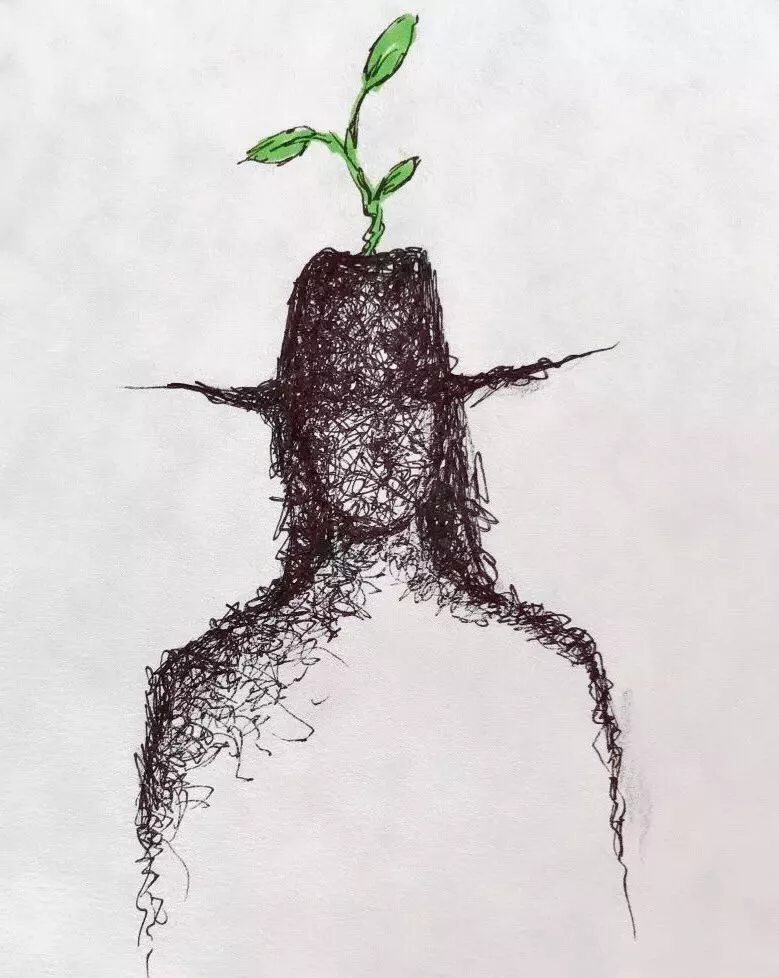
"The duality of hope and dispain,
that is part of the daily exstence in Afghanistan,
gives me the prick to keep going forward.
Hope will win over dispain."
”The duality of hope and pain is part of daily life in Afghanistan; it keeps me moving forward. Hope will triumph over pain“, said an Afghan designer. This painting was created by the grandson of Afghanistan’s last king, who is now 50 years old. He was forced to flee his homeland for the United States when war broke out in 1973, and has now returned to Afghanistan to work as an architect. He says that no Afghan ever chose to leave their homeland of their own accord; given the chance, they would return at any moment to rebuild Afghanistan.

From an Afghan artist
“For me, the driving force in life is the anticipation of a future full of hope. Hatred and such things exist only in my mind,” said an Afghan artist.
A note from our editor, Mia:
Can a thousand brilliant suns dispel the darkness brought by the smoke of war in Afghanistan? Only love can allow us to see these thousand brilliant suns.
— Khaled Hosseini, ”A Thousand Splendid Suns“
The men and women, children and young people of Afghanistan,
are filled with hope amidst the war and love their country.
For them, the meaning of life is both simple and multifaceted.
It is deeply moving to see them maintain their love for life amidst such devastation.
About the Organisation


Viva la Vida (VIVA) is a cross-cultural arts brand operating in over 60 countries worldwide, dedicated to documenting life stories through art, promoting cross-cultural understanding and social welfare. We invite people from diverse cultural backgrounds to answer the question ‘What is your life?’ through a painting, thereby documenting a variety of life stories and fostering cross-cultural understanding.
Over the past seven years, VIVA has collaborated with organisations such as the United Nations, Coca-Cola and Tencent to organise more than 400 events and collect over 20,000 life portraits, transforming individual expression into a bridge for cultural dialogue.


Comments