
Art Therapy for Refugee Trauma Recovery: Healing Trauma Through Creative Arts|VIVA LA VIDA
Updated: Aug 21
What can art do for us?
As Pablo Picasso once said, art can “wash away the dust of everyday life from the soul.” Beyond inspiring creativity, art therapy can become a powerful approach for refugee trauma recovery, helping people heal the psychological wounds caused by war, displacement, and other forms of suffering while rebuilding hope for the future.

At the end of August in Berlin, VIVA organized an art healing workshop for refugees from countries including Ukraine, Afghanistan, and Syria. The workshop integrated VIVA’s trauma-informed life education curriculum and used artistic practices such as painting, writing, and henna to help people who had lost their homes engage in self-healing through creative expression.
Understanding Trauma Responses:
The First Step in Refugee Trauma Recovery
To use art as a tool for healing trauma, people must first develop a clear understanding of their own traumatic experiences.During the warm-up session, participants engaged in guided brainstorming and tried to describe their traumatic experiences in a single sentence, preparing themselves for the healing journey ahead.

After describing their traumatic experiences, through creative arts activities, participants used colors and materials to express emotions such as safety, warmth, and anger. Through painting, they confronted painful memories and gradually regained a sense of inner peace.

Participants creating handmade crafts during a VIVA art workshop
Facing pain is difficult. However, when abstract emotions are transformed into tangible images, people begin to feel empowered to navigate complex and overwhelming emotions.The negative energy embedded in traumatic memories gradually dissolves, allowing individuals to regain emotional agency.
We collected many “life portraits” created by participants. Some depicted doves carrying olive branches, expressing a deep longing for their homeland to leave war behind and return to peace. Others portrayed beautiful natural landscapes—lush trees ,vast and magnificent oceans—reflecting a sense of vitality and renewal.Although they came from different countries and cultural backgrounds, participants shared diverse yet vibrant perspectives on life, all carrying hopes for a better future.

Artwork created by participants sharing personal stories through art
During the workshop, participants not only engaged in artistic creation but also learned about the three stages of trauma healing in psychology. The VIVA life education art workshop was co-designed with experts from the Institute of Psychology, Chinese Academy of Sciences, art therapists, and social-emotional learning experts, integrating psychological frameworks with artistic activities.Using a socio-ecological model of trauma, facilitators guided participants through four dimensions—individual, relationships, community, and society—to help them understand how current crises affect their mental and physical well-being, encouraging reflection that moves from the personal to the broader social context.

Participants also discussed the importance of self-care. Self-care is not only beneficial to the individual; it can also positively influence those around us, inspiring others through shared emotional energy and helping everyone become a better version of themselves.

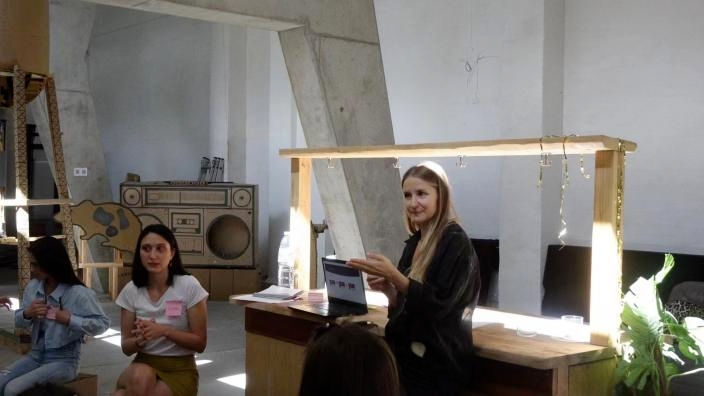
Participants discussing their ideas during a VIVA art workshop
Seeing Life Through Art Therapy:
Exploring New Perspectives After Trauma
Sharing experiences is an essential part of art-based healing. In this workshop, participants expressed their personal experiences and emotions during crises through poetry or painting, and shared their works with peers.This process of exchange and sharing not only allowed participants to express and release emotional burdens caused by crisis, but also fostered empathy and connection, enabling learning and growth through others’ stories.

In the role-play session, participants were divided into small groups and created scripts about building families in crisis situations, which they then performed. Role-play offered participants an opportunity to experience life from a different perspective.while also helping them learn how to build healthier ways of living in times of crisis.

Through these activities, participants gained insight into the diverse ways individuals respond to trauma, practiced expressing traumatic experiences in healthy and constructive ways, and formed friendships with one another.

Rebuilding Hope and Resilience Through Art Therapy and Creative Arts
Understanding trauma is not the end of healing; the ultimate goal is to help refugees rebuild hope. The first stage of rebuilding hope focused on resilience and consisted of three steps:
Step 1: “Triggering of stress responses”
When you experience a crisis—or even when someone close to you does—your stress response may be triggered and repeatedly activated, keeping you in a prolonged state of stress.
Step 2: “Coping depends on resilience”
How we respond to crises or traumatic events (COVID-19 shares many characteristics of trauma, as it is unpredictable and uncontrollable) largely depends on our resilience. Resilience refers to the ability to recover, adapt, move forward, and sometimes even grow from adversity.
Step 3: “From Stress to Resilience”
Watch video: “From Stress to Resilience” (Raphael Rose | TEDx Manhattan Beach)
After resilience training, participants created “hope bracelets.” They were divided into groups of 4–6 people and wrote inspiring words or drew powerful symbols on fabric bracelets decorated with henna patterns.After completing their bracelets, participants shared why they chose specific words or symbols, and expressed in one sentence how they felt when wearing it or seeing it around their wrist.

The workshop concluded in a moment of peace.
During the process, some cried, some laughed, some missed their homes, and some looked forward to the future.
We believe that even a small contribution that brings comfort and beauty to these lives makes all our efforts worthwhile.
What moved us even more was witnessing, through participants’ artworks, the resilience of life in the face of hardship.Whether displaced in foreign lands or confined by difficult circumstances, the moment they picked up a brush, resilience, perseverance, and vitality transformed into vivid patterns and lines—breaking through the darkness of suffering.
Isn’t this the true power of art therapy?
About the Organization


Viva la Vida is an international organization with a presence in more than 50 countries worldwide. It inspires young people to reflect on life, understand themselves, and experience life more deeply through art, fostering meaningful emotional connections with others. To date, VIVA has become a globally influential cross-cultural platform. Its partners include the United Nations, G20 YEA, APEC, Facebook, Toutiao, Alibaba, and China Unicom.


Comments