
That Slum, That School: Kenya Children's Life Stories Through Art
Updated: Sep 6
Beyond what we call “slums” lies a different way of experiencing life.
To understand them is to understand ourselves;
to support them is also to support ourselves.
Through children's life stories through art, VIVA explores the dreams, experiences, and everyday moments of children from SEED SCHOOL KIBERA. Their drawings offer a window into their lives, allowing people around the world to understand their perspectives beyond geographical and cultural boundaries.
They often say, “Hakuna Matata” (“everything will be fine”).This mindset reflects a sense of optimism deeply rooted in their culture.Once, after the midterm exams, the principal decided to organize a celebration.However, the school had very limited space available. So they removed the metal partition between two classrooms, rearranged the desks and benches, and created an open space.They brought in a large speaker, like those used for outdoor dance events, and played music. They even invited former students to return and celebrate with them.Everyone began dancing freely to the music.Both older children and younger ones danced together in this small makeshift dance floor. Their genuine passion and vitality were truly contagious.
Kenya’s Slums:
Where Children’s Life Stories Begin
Nairobi is the capital of Kenya and one of East Africa’s largest and most modern cities. It is also the country’s political, economic, and cultural center.However, behind this modern urban landscape are two of Kenya’s largest informal settlements—Kibera and Mathare. According to statistics, around one quarter of Nairobi’s population lives in these areas, making them extremely densely populated. These challenges have become a long-standing issue affecting the city’s development.
01 Kibera : A Community Beyond Labels

Historical Background
The history of Kibera can be traced back to around 1900, when it began as a small settlement on the outskirts of Nairobi. At that time, Nubian soldiers who had served in World War I were settled there by the British colonial government.Over time, other migrants also moved into Kibera and began renting land from members of the Nubian community.
After Kenya gained independence in 1963, changes in land policies gradually transformed Kibera into an informal settlement.Many residents could not afford formal housing, making informal rental structures their only available option. By the 1970s, the population had grown rapidly as landowners continued subdividing and renting out land to increasing numbers of residents.From around 1974 onward, much of Kibera gradually came under the de facto management of local residents, with a degree of tolerance or informal recognition from local authorities.
Today, Kibera is home to people from many of Kenya’s major ethnic groups, making it highly diverse. However, ethnic diversity combined with political tensions has also led to recurring conflicts throughout its history.

Living Conditions
Many residents of Kibera face extreme economic hardship, with daily incomes often below $1. A common source of income is charcoal production and sales.Unemployment rates are extremely high, reaching around 80%.
Many residents lack reliable access to basic services such as electricity, clean water, and healthcare.Only about 20% of residents have access to electricity, and adequate sanitation facilities are extremely limited.
Drug abuse, alcohol abuse, and HIV/AIDS affect roughly 20% of the population. Waste accumulation and poor sanitation remain serious challenges in the community.Traffic conditions are often challenging, as vehicles and pedestrians share narrow paths with limited regulation.These issues have persisted for a long time.
02 Mathare: Understanding Children’s Lives Beyond the Labels of a Slum

Historical Background
Mathare was once part of the wider Nairobi informal settlement area and originally served as a quarry site.During the colonial period, workers from Asia were brought here to extract materials for railway construction. During the 1950s, the Mau Mau uprising took place in Kenya, and the area was reportedly used by revolutionaries to hide weapons. Over time, it gradually developed into a settlement.
After independence, the Kenyan government faced challenges in effectively managing urban land use. As a result, many people seeking affordable housing moved into the area, and Mathare gradually developed into the community it is today.Around 2010, a highway connecting Nairobi’s city center with the Ethiopian border was built nearby, further increasing population density and contributing to the area’s expansion.
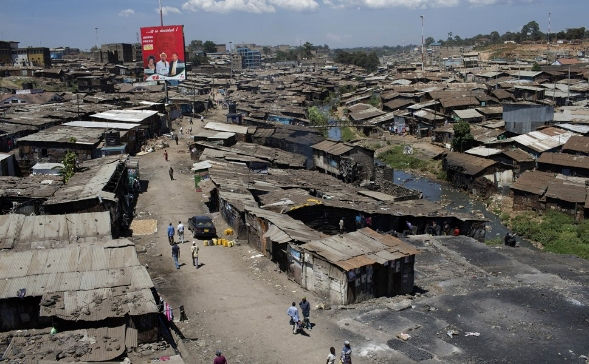
Crowded and Modest Living Conditions
Living Conditions
Many residents live in small structures made of corrugated metal and mud, often without beds, electricity, or running water.Some residents sleep on floors or cardboard sheets inside these homes.Public toilets may be shared by up to 100 people and often require a small fee.Those who cannot afford the fee may have no choice but to use nearby alleys or drainage channels.
In an environment where sanitation services are extremely limited, the practice known as “flying toilets” emerged—some residents disposed of waste-filled plastic bags by throwing them into the Mathare River at night.Ironically, the river is also an important water source for the community, creating further health risks.
Around 600,000 people live in an area of roughly 3 square miles, with many residents earning less than $1 per day.Crime and HIV/AIDS remain significant challenges in the community.Some children lose parents to illness and are forced to take on responsibilities beyond their age.
In the Mathare area, only a few schools serve approximately 70,000 children.Due to financial hardship, many children are unable to continue their education. In addition, social pressures around early marriage can also limit girls’ access to education.

For those who have never lived there, slum life may seem unbearably harsh and deeply damaging to its residents.But in reality, despite the hardships they face, many people in the slums have not lost hope for the future.
A local woman named Mary, after recognizing the difficulties faced by women in her community, launched the “Mama Africa” initiative.The program helps local women become financially independent by teaching them craft-making skills, providing raw materials, and supporting them in selling their handmade products to earn a living.
People try every possible way to earn money just to meet basic needs. Even young children are exposed to hardship early in life and are forced to face life independently at a very young age.
Diddy’s Story: A Child’s Perspective on Life in Kibera
In Kibera, there is a boy named Diddy. He has three sisters. His given name is Vitalis Odhiambo, but his friends call him Diddy.His family lives in a room smaller than 9 square meters. As the only boy in the family, he sleeps on a narrow bench, while his sisters sleep on the floor.His mother sells vegetables, and his father works as a security guard.From a young age, his parents were only able to provide basic necessities such as food.
Other needs, such as clothing, had to be taken care of by the children themselves.“At first, I collected scrap metal and wood and sold them to local traders. With that money, I could buy clothes for myself. It taught me responsibility from a very young age.Later, I also worked at construction sites and car washes to earn money. It was this period of my life that changed everything.”
When Diddy talks about life in Kibera, his eyes light up with pride.He says,“I really love the smiles of people in Kibera. Kibera is like a city within a city. Everyone treats each other like family and shows kindness to one another. You never feel alone.People here are also very creative, because daily life requires creativity. It’s this atmosphere that makes me love my neighbors.”
Despite the challenges they face, people in Kibera continue to look toward the future with hope. They find ways to make a living, and many children take on responsibilities at an early age.
Local residents and the government are working to improve living conditions in these communities.However, long-standing structural conditions and deeply rooted environmental challenges make this process extremely difficult and slow.Continued support from around the world can help improve living conditions, provide better infrastructure, and ensure that children’s hopes can continue to shine.
A Volunteer’s Story:
A Day in the Lives of Children
At first glance, the living conditions and safety situation in Mathare may seem to be summed up in three words: “dirty, chaotic, and difficult.””For first-time visitors, the unfamiliar environment and difficult living conditions can easily create feelings of anxiety and uncertainty. It can be difficult to imagine what it would be like to live here long-term.However, for children who have grown up here, these surroundings have become part of everyday life.The crowded streets, muddy paths, worn-down houses, and open drains are simply part of their daily lives.

Every morning, the children skillfully step over puddles and piles of trash, often holding their breath to avoid the strong smell in the air.Some arrive early at school to study, while others rush through household chores or take care of younger siblings before heading to class.
By 8 a.m., the children are ready for class. Mornings are filled with anticipation, because they know that a free lunch will be provided at school at noon.

Ugali is a traditional local staple and a common school lunch.
The school has eight grade levels. When it is mealtime, older students first help the younger ones collect their food and utensils.They then form lines and pass the meals along from the hallway into the classrooms, one by one.Only after taking care of the younger children do the older students begin eating.

Queue up to collect lunch.

Passing the lunch along.
Despite the difficult environment, teachers in slum schools are no different from teachers elsewhere. They teach knowledge and care deeply for their students.They are also very welcoming to new volunteers, kindly sharing daily tips and advice to help them adapt more quickly to the local environment.

Students attending a mathematics class.
Every Wednesday afternoon, the school organizes outdoor activities where both teachers and students can enjoy time under the sun.However, due to limited space and funding, the school has no playground or proper sports facilities. Instead, a shared sandy field in the slum serves as their activity ground.
For older students, football is the most common form of entertainment, and teachers sometimes join in, running and playing together in the sun.For younger children, teachers lead games, songs, and dancing activities.Even when dozens of children crowd around a single ball or end up covered in mud, their faces are filled with the most genuine and joyful smiles.

Students are playing football.

Students are playing football, without a basketball, the children use a football to play a basketball-style game.

Teachers playing games with the children.
Compared to younger children, seventh- and eighth-grade students appear more mature and often take on the role of older brothers and sisters, helping the younger ones in daily school life.
Through conversations with eighth-grade students, it becomes clear that they are eager to continue their education—moving on to secondary school and university, and eventually securing decent jobs and a better life outside the slum.However, some children are forced by economic hardship to learn vocational skills and begin earning money at an early age. Only a small number of lucky students are able to graduate from primary school and continue to secondary education.
Children’s Life Stories Through Art:
Stories Told Through Drawings
We Live Here
An ordinary life is never truly dull.Those with a sensitive eye can always discover a special kind of beauty, shining brightly on paper.

▲ Living under the same roof with animals; a woman taking care of children at home.

▲ Daily chores and the occasional surprising experience of tooth extraction.

▲ Picking and eating fruit with mom.

▲ Children playing and chasing dogs.

▲ Working.

▲ Walking home hand in hand in everyday life.

▲ Farming in the fields.


▲ Our home.

▲ Hospitals and pharmacies.


▲ Children’s perception of life does not involve many complex concepts or theories. Instead, life is expressed in a rich and imaginative way. Food, clothing, shelter, and daily routines make up most of their lived experiences—direct and simple. You can also directly feel this through their drawings.


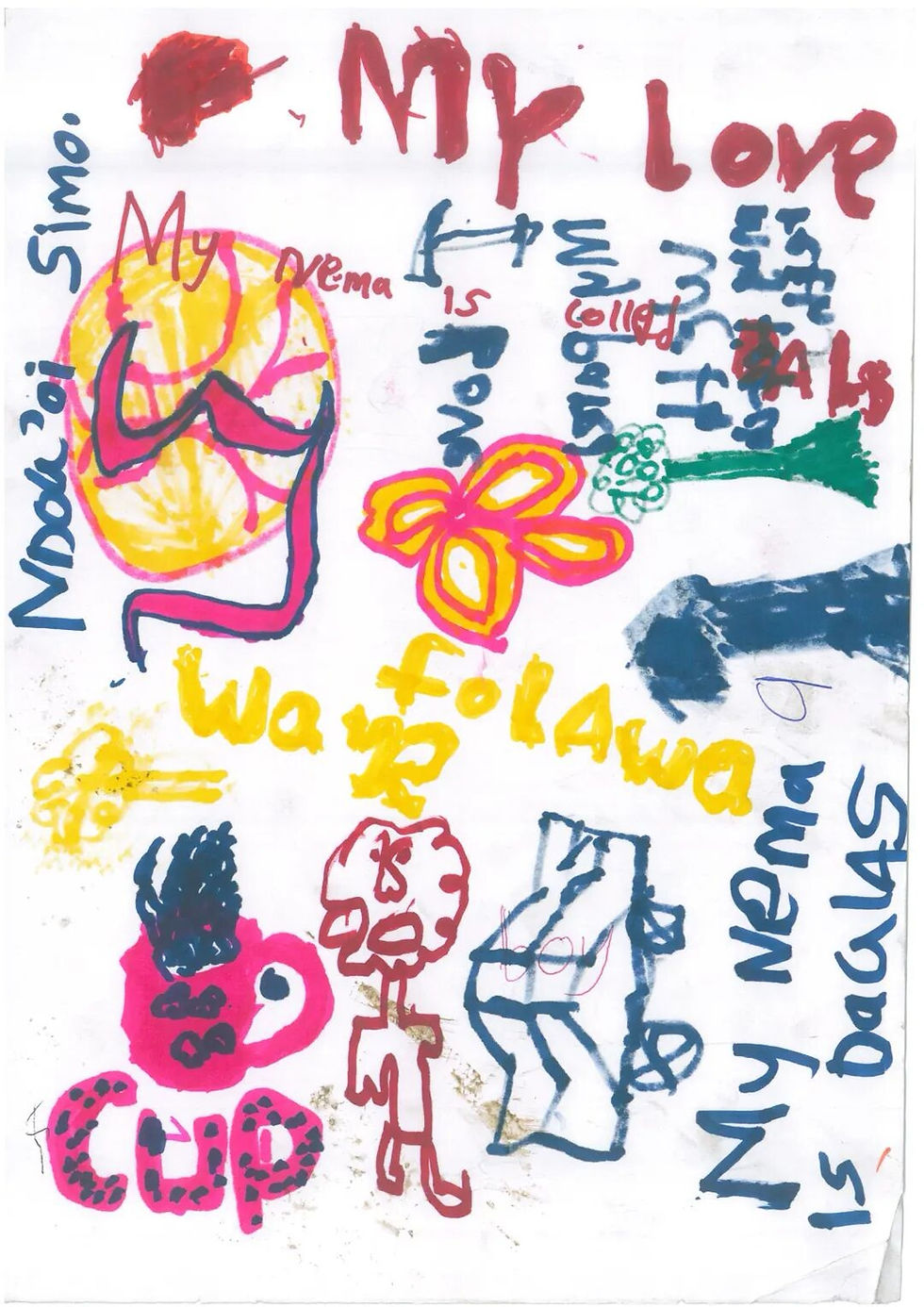
What Is Life?
In the quiet moments of daily life, questions about existence often emerge naturally, waiting to be recorded.Through their drawings, Kenyan children share their life stories through art, revealing their understanding of family, nature, dreams, and everyday life.

▲ Fourteen-year-old Eddy divides life into several stages: birth, learning, understanding, fulfillment, and ending. Compared to other children in the Kibera slum, he is able to view life from a more mature and broader perspective.
We often overlook the diversity of individual thoughts due to the stereotypical image of Kibera as a slum. Perhaps for some children, material satisfaction is already the greatest form of happiness; while for others, the deeper desire is not just to survive, but to truly live.

▲ Fourteen-year-old Louise seems to approach life mainly through perception and understanding. Through his way of depicting different human expressions in daily life, he indirectly reveals his own “way of seeing the world.”
In his written description, he says that people sometimes feel fear, sadness, happiness, anxiety, shyness... These emotions are unavoidable in human life and run through our entire existence.

▲ Hedy believes that life is a challenge. The world is divided into towns and rural areas, and human emotions move back and forth between these different worlds.
Every day, early or late, whether in villages or in towns, people laugh, cry, and feel anger.

▲ Life is constantly changing. The most obvious and profound changes in life are reflected in human appearance—from youthful, innocent faces to weathered, experienced ones. Within them lie stories unknown to others.

▲ The changes in life are also reflected in different moments of existence,
each carrying different feelings and different ways of thinking.

▲ Jostos expresses his understanding of life entirely through his paintings.
For him, life is everything that can be felt within the frame of a picture.

▲ The present moment is life itself.

▲ The meaning of life is to help others.
Fourteen-year-old Asha hopes to become a teacher when she grows up, so she can help more people in the future.

▲ The meaning of life is closely tied to everything around us in the present moment. In his drawing, Movet depicts the people and things that currently matter most to him—his family, friends, and nature, all of which make life feel real to him.A child’s perspective can offer us a different kind of insight: it makes us wonder whether our search for the meaning of life has actually drifted too far away from our everyday existence.

▲ Life is like a tree: it grows step by step, just like a seed slowly developing into a towering tree, and human growth follows the same pattern. At the end of life, Duncan uses a fallen tree to represent old age, eventually turning into firewood. What a person leaves behind in the world is also like this wood—something that remains in others’ memories.
Becoming: Children’s Dreams and Hopes for the Future
Looking toward the future is something we naturally learn to do.Through art, children express not only who they are today, but also who they hope to become in the future.Rooted in the present, the futures imagined by these children feel so vivid and touching. How different are these dreams from our own?

▲ Chalton, who dreams of becoming a pilot.

▲ Nine-year-old Andre understands the importance of education for his future and is also aware of his family’s difficulties. He studies hard,
hoping that one day he can attend university and find a good job to help support his family.

▲ Because of their love for teachers, children often develop a strong admiration for the profession.
Failh looks forward to having her own house in the future.

▲ Naomi says she is willing to help the people who build hospitals and houses,
offering them whatever support she can.

▲ Mchere hopes to become a professional football player in the future.

▲ Shantal wants to become a teacher.

▲ Racl wants to become a pilot.

▲ Mary imagines becoming a farmer.
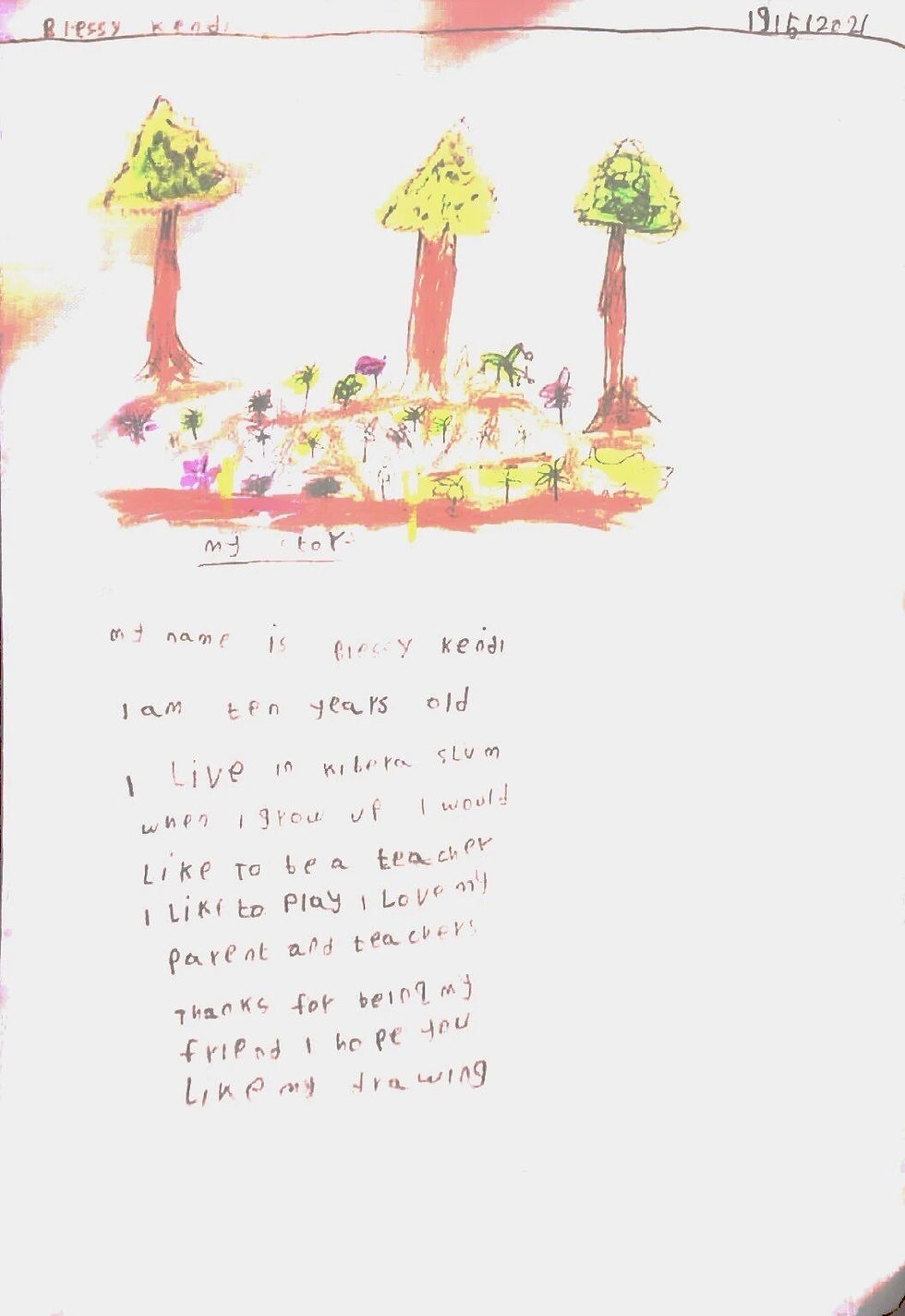
▲ Clessy wants to become a teacher.

▲ Byro wants to become a football player.

▲ Witny wants to become a nurse.

▲ Givffin wants to become a farmer.
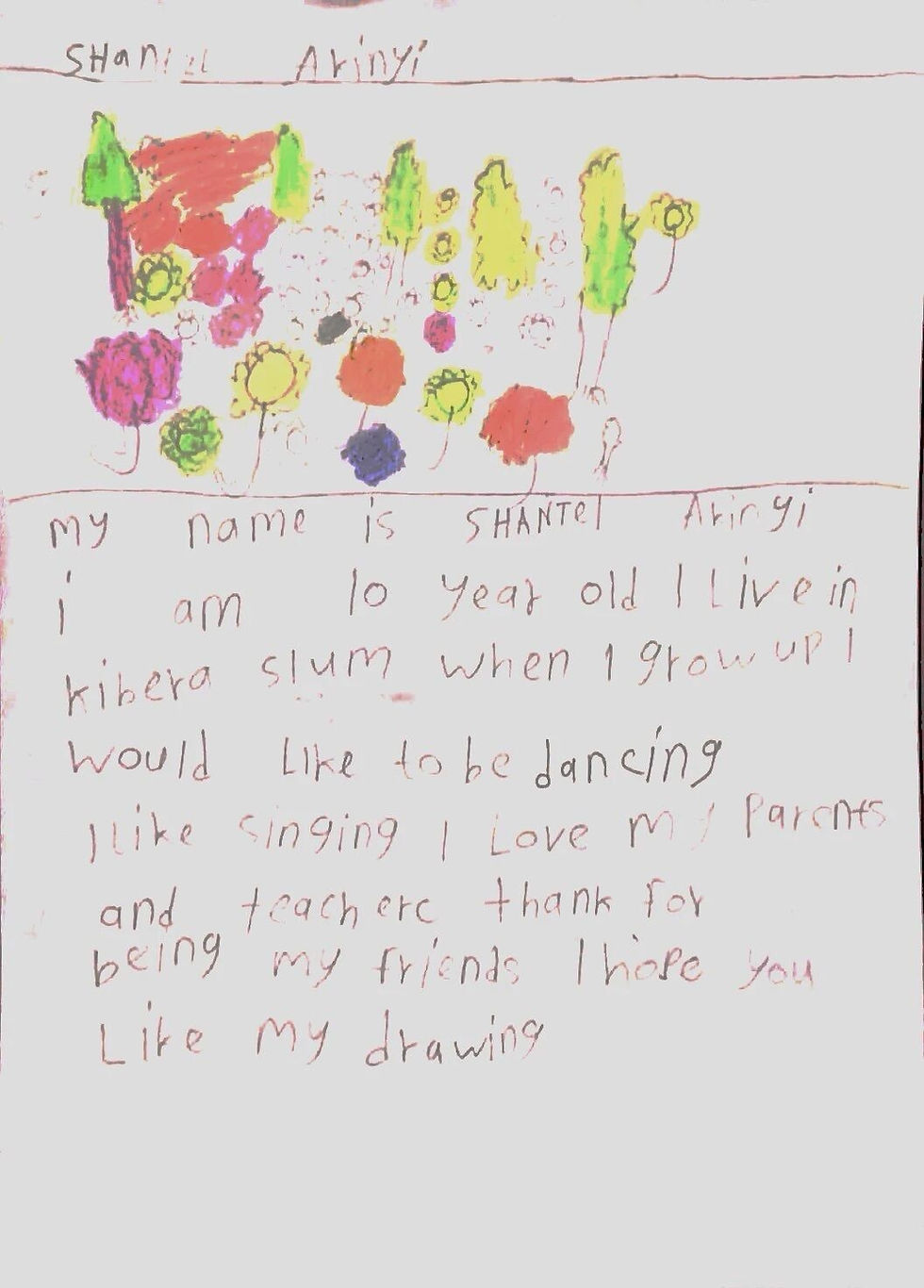
▲ Shantel wants to become a dancer.

▲ Beryl wants to become a singer.
Moments of Connection:
Creating Stories Through Art

▲WanHang:
The colors of the egg combine the bright, fluorescent tones often seen in children’s drawings, blending ideas of the slum (harsh reality) and the school (hope). It represents new life and a future being nurtured on the land of the settlement.


▲Rita Lee : Amid chaos, there is still hope.

▲“This Time” — Yelin Zhou
On a very high mountain, the environment is not particularly favorable. Most of the ground is covered with stones, making it difficult for large trees to grow. Yet, there are small wildflowers of various colors.The melted snow from the mountains flows down to nourish them, and the sunlight is also abundant. The flowers bloom beautifully.This feeling suggests that no matter the environment, nothing can truly prevent natural beauty from flourishing—just like children.
SEED SCHOOL KIBERA:
Creating Opportunities Through Education and Art
Kenya provides compulsory education in principle, but families are still required to cover many additional costs, such as meals, textbooks, and school uniforms. Many families cannot afford these expenses, which ultimately leads to a situation where children cannot go to school without money. As a result, compulsory education is often free in principle but inaccessible in practice for many families.Without proper education, children find it difficult to secure jobs in the future. Without access to education, some children become more vulnerable to crime and other harmful influences.

Patrick Aouki was able to complete his education with the support of Save the Children, during his childhood. After graduating, he wanted to help other children who were unable to attend school. He then came to Kibera and founded SEED SCHOOL , providing free education for grades 1–4 to children in the community, with the hope that SEED SCHOOL KIBERA could become a gateway to education for children who have been excluded from education.
Currently, the school has eight classes and serves 177 children aged between 3 and 14. Since its establishment in 2007, it has provided free education to more than 600 children.
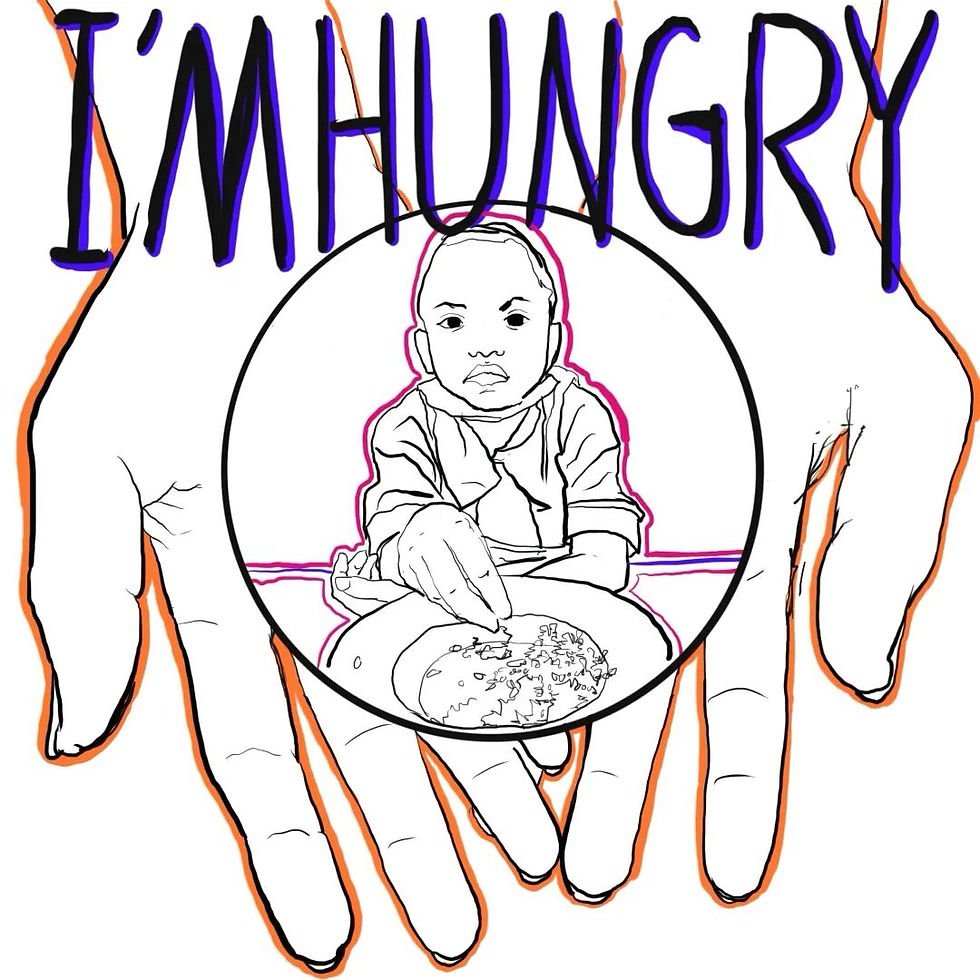
Because many families are unable to provide basic necessities for their children, the school also runs a daily feeding program. This allows students to focus fully on their studies while supporting their healthy physical and emotional development.After students complete primary education, Patrick also works hard to help graduates continue their education by finding places for them in other tuition-free schools. so they can continue their studies. However, due to real-world constraints, just over half of the students are able to continue their education.

The school is still facing many challenges. Limited infrastructure, a lack of equipment and operational funding, insufficient staff, and a shortage of teaching materials all limit the quality of education. The COVID-19 pandemic has made these challenges even greater.

Patrick Aouki, Principal of SEED SCHOOL KIBERA
The principal of the school, Patrick Aouki, hopes to collaborate with Viva. He deeply values Viva's commitment to respecting every life and every story. In return, Viva will bring fresh inspiration to the school's art education program.Patrick is very happy to share these unique stories of the children with a wider audience. He hopes to help more people in China learn about the children and their community. so that more people can better understand the lives and stories of the people who call this place home, and he also looks forward to more opportunities for deeper exchanges between SEED SCHOOL and friends in China.
Helping Hands:
Connecting Children’s Lives Through Art
Viva la Vida, in collaboration with SEED SCHOOL KIBERA, shares the life stories of the children at the school, inviting people from all walks of life to better understand the children and support their future.

A single beam of light can illuminate a vast piece of land.
A single act of love can change a person’s destiny.
Stories from African informal settlements may seem far removed from our own lives, but through these drawings, we can catch a vivid glimpse of both the beauty and the harshness of the world in which these children—each as an individual—live.Through children's life stories through art, we discover that every child has a unique story worth listening to.Their lives are connected with ours in ways we often fail to notice. In the same way, And in ways both small and unseen, our choices can shape theirs as well.


Comments